
A build contract is a legally binding agreement between a property owner and a contractor that defines the scope of work, cost, timeline, and responsibilities for a residential construction project. In plain terms, it is the document that governs every significant decision made on site, from the first foundation pour to the final snag list. Understanding what a build contract means before you sign one is the difference between a project that runs to plan and one that unravels into disputes and unexpected costs. The industry standard term is a construction contract, though "build contract" is the phrase most residential owners use in practice.
What does a build contract mean in practice?
A build contract is, at its core, a risk-allocation document that sets out who is responsible for what, and who bears the financial consequences when things do not go to plan. It is not a formality. It is the financial control mechanism for your entire project.
The contract establishes the legal relationship between you as the owner and your contractor. It names the parties, describes the project, and creates enforceable obligations on both sides. In some jurisdictions, the contract carries statutory weight. In New South Wales, for example, projects over $20,000 require a formal large job contract with specific compliance clauses. While UK regulations differ in their detail, the principle is identical: residential construction above a certain value demands a written, legally compliant agreement.

What surprises many owners is how much a well-drafted contract does beyond recording the price. It sets the standard for quality, the process for resolving disagreements, and the mechanism for handling changes. Without those provisions in writing, every grey area becomes a potential argument.
What are the key components of a build contract?
A thorough build contract covers six areas that every owner should read carefully before signing.
- Scope of work and specifications. This section describes exactly what the contractor will build, to what standard, and using which materials. Vague scope is the most common cause of disputes in residential construction. If the specification says "kitchen units to be agreed," that is a gap that will cost you money later.
- Cost and payment terms. The contract should state the total price or the basis for calculating it, along with a progress payment schedule tied to defined milestones. Payments linked to milestones protect you from paying ahead of completed work.
- Project timeline and milestones. Start date, practical completion date, and key interim milestones should all appear in writing. The contract should also state what happens if the contractor misses them.
- Risk allocation. This covers who is responsible for unforeseen ground conditions, weather delays, material price increases, and similar events. The contract determines whether those risks sit with you or your contractor.
- Change management. Any deviation from the agreed scope should follow a formal change order process. Unsigned change orders are one of the most reliable ways for unexpected charges to appear on your final account.
- Standards and compliance. The contract should reference applicable building regulations, planning conditions, and quality standards. Courts may imply some of these obligations even when the contract is silent, but voluntary inclusion removes ambiguity.
Pro Tip: Read the change order clause before anything else. If the contract does not require written, signed approval before variations are carried out, negotiate that in before you sign.
What types of build contracts exist, and how do they differ?
Contract structure determines who absorbs cost overruns and delays, so the choice of contract type is one of the most consequential decisions you will make at the start of a project.
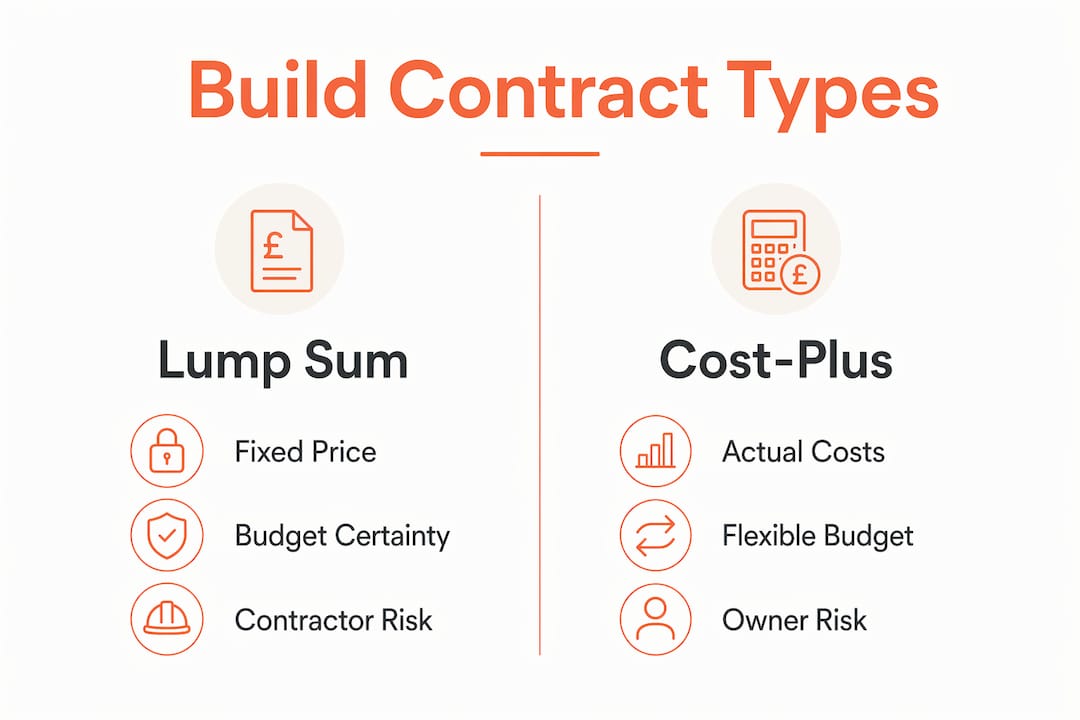
The three models most relevant to residential builds are lump sum, cost-plus, and design-build.
| Contract type | How cost is set | Budget certainty | Best suited to |
|---|---|---|---|
| Lump sum (fixed price) | Agreed total before work starts | High | Fully designed projects with complete drawings |
| Cost-plus (with or without GMP) | Actual costs plus a fee | Low to medium | Projects where design is still evolving |
| Design-build | Single entity for design and construction | Medium to high | Owners who want one point of responsibility |
A lump sum contract gives you a fixed price before work begins. The contractor takes on the risk of cost overruns, which is why this model suits projects with complete, detailed drawings. If the scope is not fully defined, the contractor will price in a contingency, and you may pay for risk that never materialises.
A cost-plus contract charges you the actual cost of labour and materials, plus an agreed fee or percentage. It offers flexibility when the design is still developing, but it transfers budget risk to you. A Guaranteed Maximum Price (GMP) variant caps your exposure at an agreed ceiling, giving you some protection without sacrificing flexibility.
A design-build contract places both design and construction under one entity. This model is growing in popularity for residential projects precisely because it removes the traditional friction between architect and builder.
Pro Tip: Choose your contract type based on how complete your design is. A lump sum contract on an incomplete design is not a fixed price. It is an invitation for change orders.
How does a design-build contract work for residential projects?
A design-build contract means a single organisation is responsible for both the architectural design and the physical construction of your home. You have one contract, one point of contact, and one party accountable for the outcome.
The practical advantage is coordination. In a traditional procurement model, the architect produces drawings and the contractor builds from them. When problems arise, each party can point at the other. In a design-build arrangement, design and construction teams work collaboratively from the project's start, which removes that adversarial dynamic entirely.
Cost feedback is the other significant benefit. Because the design and construction functions sit within the same organisation, cost estimates are produced continuously as the design develops. You know what your choices cost before they are committed to drawings, which means budget surprises are far less common. Continuous cost feedback during the design phase is one of the defining advantages of this model.
Design-build contracts are typically structured as either a lump sum or a GMP, agreed once the design has reached a sufficient level of detail. The overlap between design and construction phases also tends to shorten the overall programme, which matters when you are managing temporary accommodation or bridging finance.
What risks should property owners watch out for in build contracts?
Most disputes in residential construction do not start on site. They start in the contract, or more precisely, in the gaps the contract leaves unfilled. These are the risks worth examining before you sign.
- Incomplete scope. If the scope of work does not describe every element of the project in detail, the contractor is entitled to price variations for anything not included. A vague specification is a blank cheque.
- No formal change order process. Verbal agreements to change the design or specification are unenforceable in most circumstances. Without a signed change order, you have no agreed price for the variation and no record of who approved it.
- Misreading payment terms. Progress payment schedules that front-load payments in favour of the contractor leave you with limited leverage if quality falls short. Payments should track completed, inspected work.
- Ignoring implied warranties. Courts can read obligations into a contract that the document does not explicitly state. Implied warranties and safety standards may apply to your project regardless of what the contract says, so understanding local building regulations is not optional.
- Overlooking dispute resolution clauses. If the contract does not specify a resolution process, a disagreement defaults to litigation. Adjudication or mediation clauses are faster and cheaper alternatives worth including from the outset.
Pro Tip: Ask your solicitor or a construction consultant to review the contract before you sign. The cost of a two-hour review is negligible compared to the cost of a disputed final account.
How should property owners approach negotiating a build contract?
Negotiating a build contract is not about driving the hardest possible bargain. It is about achieving clarity before work starts, so that both parties understand their obligations and the project can proceed without unnecessary friction.
- Define the scope in writing before negotiating price. A contractor cannot give you a reliable price for work that has not been fully described. Invest in complete drawings and a detailed specification first.
- Agree the change order process explicitly. State that no variation will be carried out without a written instruction from you and a written price from the contractor, both signed before work proceeds.
- Tie payments to milestones, not dates. Progress payments linked to inspected, completed stages protect your cash position and give you a mechanism to pause payment if quality is not met.
- Seek professional advice when the contract is complex. A solicitor with construction experience, or an independent project manager, can identify unfavourable terms that a non-specialist would miss. Proper contract management tracks scope, changes, payments, and timelines throughout the project life cycle.
- Maintain regular communication with your contractor. Contracts are not substitutes for good working relationships. A monthly site meeting with a written record of decisions made is one of the most effective ways to prevent small issues from becoming formal disputes.
Key takeaways
A build contract is the single most important document in any residential construction project, and its quality determines whether the project is controlled or chaotic.
| Point | Details |
|---|---|
| Core definition | A build contract is a legally binding agreement covering scope, cost, timeline, and risk allocation. |
| Contract type matters | Lump sum suits complete designs; cost-plus suits evolving ones; design-build suits owners wanting one point of accountability. |
| Scope clarity is critical | Vague scope is the leading cause of disputes and unexpected costs in residential construction. |
| Change orders protect you | Every variation must be agreed in writing before work proceeds to avoid unauthorised charges. |
| Implied obligations exist | Courts may read warranties and compliance requirements into contracts even when the document is silent. |
Why I think most owners underestimate what a build contract actually does
Most people treat a build contract as a legal formality. Something to sign so the work can start. In my experience, that misunderstanding is the root cause of most of the disputes I have seen on residential projects.
A contract is not a handshake in writing. It is a financial control document. Every clause either protects your budget or exposes it. The scope section determines what you are paying for. The payment schedule determines when your money leaves your account. The change order clause determines whether you have any control over cost once the project is underway.
The owners who have the smoothest projects are not the ones who negotiated the lowest price. They are the ones who spent time on the contract before work started, agreed every detail of the scope, and insisted on a formal process for any changes. They treated the contract as a management tool, not a legal obligation to be filed away.
Design-build models, in my view, reduce a significant amount of owner stress precisely because they eliminate the gap between what the architect draws and what the contractor prices. That gap is where most residential project budgets collapse. When design and construction sit under one roof, the feedback loop is immediate and the accountability is clear.
If you are planning a residential build, read your contract before you read your drawings. The drawings tell you what you are building. The contract tells you whether you are in control of it.
— David
How Coburnproperty can help with your residential build

Coburnproperty works with residential clients from the earliest stages of a project through to completion, with a focus on ensuring the finished home genuinely works for the people living in it. That includes helping clients understand and navigate the contractual side of their build, from selecting the right contract structure to reviewing terms before signing. If you are planning a residential project and want an independent view on how to approach the contract and procurement process, Coburnproperty's residential build management service is the place to start. You can also explore completed residential projects to see how Coburnproperty has managed design and construction delivery in practice.
FAQ
What is a build contract in simple terms?
A build contract is a legally binding written agreement between a property owner and a contractor that sets out the scope of work, the price, the timeline, and each party's responsibilities. It is the document that governs the entire construction project.
What is the difference between a lump sum and a cost-plus contract?
A lump sum contract fixes the price before work begins, giving the owner budget certainty, while a cost-plus contract charges actual costs plus a fee, offering flexibility when the design is not yet complete. Owners should choose based on how fully developed their design is before procurement.
What is a design-build contract?
A design-build contract places responsibility for both design and construction with a single entity, removing the traditional separation between architect and builder. This model reduces disputes, improves cost feedback during design, and typically shortens the overall project programme.
Do build contracts include legal protections automatically?
Some protections, including implied warranties and compliance with building regulations, may be read into a contract by courts even if the document does not state them explicitly. Owners should not rely on implied terms and should verify that all relevant obligations are written into the contract directly.
What happens if the scope of work is not clearly defined in the contract?
Unclear scope is the most common cause of disputes and cost overruns in residential construction. If the scope does not describe the work in sufficient detail, the contractor can raise change orders for anything not explicitly included, which drives up the final cost.